
SaaS solution

ERP for livestock farms

Record every production stage, health history and weighing, and control dispatch and sales without notebooks or spreadsheets.

  • For: Livestock farms

Your farm under control, no notebooks needed

Record every stage, health history and weigh-ins for your animals, and manage dispatches and sales from one system.

  • Stage-by-stage records
  • Health history
  • Weigh-ins and dispatch

Challenges it solves

Problems it solves

  • Breeding records kept in notebooks that never get consolidated.
  • Vaccines and treatments with no schedule or history.
  • Weight gain that isn’t measured until the sale.
  • Dispatch and sales disconnected from the animal inventory.
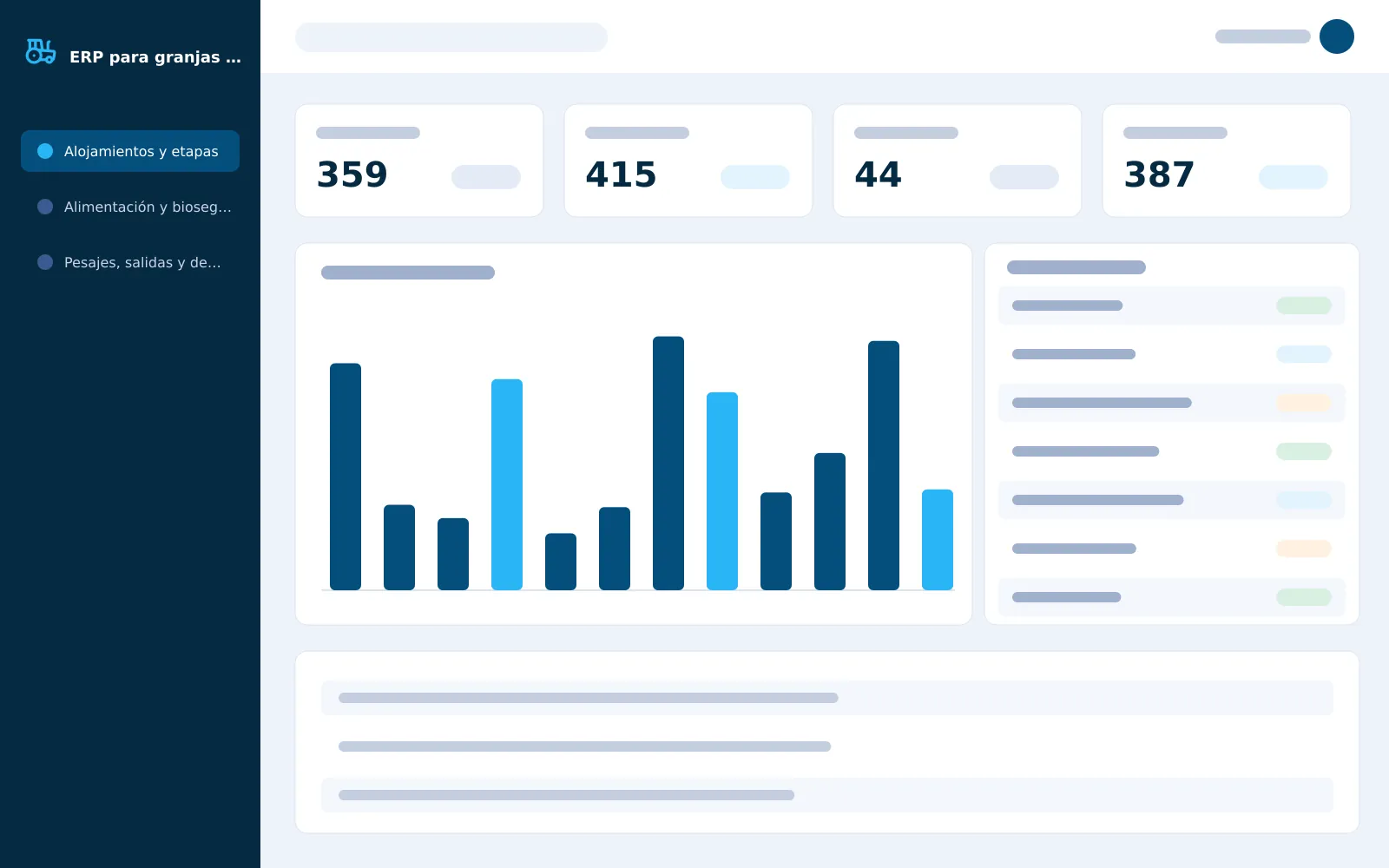
Farm ERP screenshot

Features

Modules

Housing and stages2

  • Production stages

    Farrowing and nursing, rearing, fattening and breeding stock.

  • Pens and cages

    Animals recorded by pen or cage, managed as groups or individually.

Feeding and biosecurity3

  • Feeding

    Control of balanced feed, forage and water.

  • Animal health

    Treatments, deworming, vaccines and medication.

  • Quarantine and biosecurity

    Quarantine control and disinfection checkpoints.

Weighing, dispatch and waste3

  • Sorting and weighing

    Weight gain and classification for sale.

  • Dispatch and sales

    Live animals or transfer to processing.

  • Composting

    Waste control and organic fertilizer production.

Advantages

Benefits

What you gain by leaving notebooks and spreadsheets behind.

  • Everything in one record

    Animals, feeding, health, weighing and dispatch live in the same system, not in scattered notebooks.

  • Complete health history

    Treatments, deworming, vaccines and medication recorded for each pen, cage or animal.

  • Measured weight gain

    Weighings show how each group is progressing and help classify animals for sale.

  • Biosecurity under control

    Quarantines and disinfection checkpoints with their own records.

  • Dispatch linked to inventory

    Live-animal sales and transfers to processing are deducted from the animal inventory.

  • Waste put to use

    Waste control and organic fertilizer production are recorded too.

Ideal for

Who it’s for

  • Farms with pens or cages and several breeding stages.
  • Producers selling live animals or for processing.
  • Farms that need health records to pass inspections.

Guide to digitizing farm management

Moving from notebooks to a system is a change of habits more than of technology. This guide explains what a farm gains with an ERP, how it is implemented and what information to gather beforehand.

What advantages does an ERP have over notebooks and spreadsheets?

On many farms the information exists, but it is scattered: one notebook for feeding, another for vaccinations and a spreadsheet for sales. Consolidating it takes time and, when you need a piece of data, it is not always at hand.

A farm ERP brings everything into a single record. Each pen or cage has its animals, stage, feeding and health history; weighings show each group's weight gain; and dispatches are deducted from the animal inventory. That way you can see the state of the farm without waiting to gather paperwork, and the information remains available even if staff change.

Why do health and biosecurity records matter?

Treatments, deworming and vaccinations have dates that cannot be missed, and when a health problem arises you need to know quickly what was applied, where and when. If everything is on paper, reconstructing that history is hard.

The ERP keeps the health history of each pen, cage or animal, together with quarantine and disinfection point control. Having that information organized makes it easier to respond when it is requested during an inspection and to make decisions based on data, for example when checking whether a group needs attention before moving to the next stage.

What does implementation look like, and what data should you prepare?

We start by getting to know your farm: which species you raise, how pens or cages are organized, which stages you manage and whether you work by group or by animal. With that, we assess whether the solution fits as it is or what needs adapting with custom software.

Before loading the system, gather the current animal inventory by location and stage, recent health history, the types of feed you use and your customers or sales destinations. It does not have to be perfect: what matters is starting from a reliable count. Then we train the people who record information on the farm and provide ongoing support.

What should you measure once the system is running?

The most valuable figure is usually weight gain per group, because it shows whether feeding and management are working. Comparing it across pens or cages helps you spot differences early, not only at the time of sale.

It is also worth checking that treatments and vaccinations are recorded when they are applied, how animals move between stages and whether dispatches match the inventory. Composting control shows how much organic fertilizer is obtained from waste. The key is to record daily: a system with incomplete data does not reflect the reality of the farm, so the team's consistency is the first thing worth looking after.

Request a demo

We’ll show you the solution running and assess together how it fits your operation.

Case study

Agropecuaria Don Guando

Peruvian producer selling guinea pig, rabbit, pork and other farm products. We built its farm ERP, along with its CRM and online order automation.

Visit site

FAQ

Frequently asked questions

Another question? Write to us and we’ll get back to you shortly.

What does the system record?

Animals by pen or cage and stage, feeding, health, quarantines, weighing, dispatch and compost production.

Does it work for my type of farm?

Tell us which species you raise and how your farm is organized, and we’ll assess whether the solution fits or what needs adapting.

What is a farm ERP?

It’s a management system that brings breeding information into one place: animals by stage, feeding, health, weighing, dispatch and waste.

Which breeding stages does it cover?

Farrowing and nursing, rearing, fattening and breeding stock.

Can I manage animals as groups or individually?

Yes. Animals are recorded by pen or cage, managed as groups or individually.

Does it help with health inspections?

The system keeps the history of treatments, vaccines, quarantines and disinfection, which makes it easier to have the information organized when you need it.

Do you have experience with farms?

Yes. We built the farm ERP for Agropecuaria Don Guando, along with its CRM and online order automation.

How long does implementation take?

It depends on the species, the size of the farm and what needs adapting. We define it with you in the proposal.

Does it include training and support?

Yes. We train the people who record information on the farm and provide ongoing support; the scope is defined in the proposal.

Do you work with farms outside Peru?

Yes. We work remotely with clients in Peru and other countries. Tell us about your case and we’ll assess it.

Which GSCREATIVAS services support the implementation?

Depending on your project, we complement it with Custom software development and Cloud architecture. If your process needs something the solution doesn't cover, we build it custom.

No-obligation quote

Is your farm still run on notebooks?

We’ll show you how to keep every stage under control.

Request information

Which process you want to improve, timelines and anything useful.

Is your farm still run on notebooks?

We’ll show you how to keep every stage under control.